

No products in the cart.

Why Jumbo Triangular Pencils Improve Grip Strength
- Mark Yang
- May 14, 2026
- 7:15 pm
- No Comments
Table of Contents
Handwriting is often viewed as a cognitive task, but it is fundamentally a mechanical one. For a young child or an individual with fine motor challenges, the act of holding a pencil is the first hurdle in a long journey toward literacy and self-expression. When a learner struggles with a “death grip” or experiences hand fatigue after just a few sentences, the issue rarely lies with their effort. Instead, it often stems from the physics of the writing instrument itself.
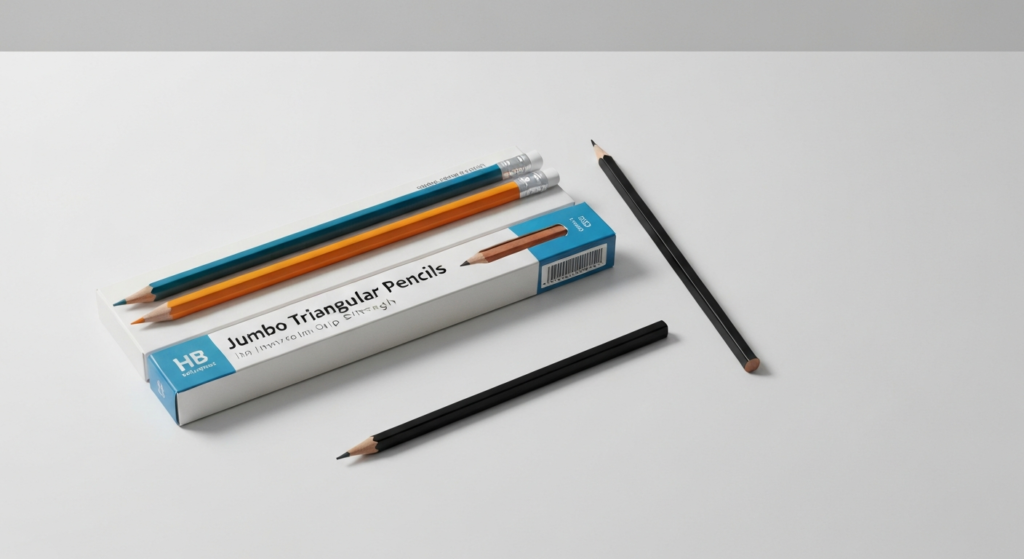
The transition from the palmar grasp of a toddler to the sophisticated tripod grip of a student requires specific muscle development and tactile feedback. This is where jumbo triangular pencils serve as more than just stationery; they are developmental tools designed to align with the natural anatomy of the human hand. By providing a larger diameter and three distinct flat surfaces, these pencils simplify the complex geometry of finger placement.
In this deep dive, we will explore the physiological and ergonomic reasons why the shape and scale of your writing tool dictate the strength and endurance of your grip. We will also look at how educators and occupational therapists utilize these tools to bridge the gap between early scribbling and refined penmanship.
The Geometry of the Tripod Grip
The “functional tripod grip” is the gold standard of handwriting. It involves the thumb and index finger pinching the pencil while it rests comfortably on the side of the middle finger. Traditional round or hexagonal pencils, while iconic, offer very little guidance for this placement. A round barrel provides an infinite number of contact points, which often leads to fingers overlapping or sliding into a “quadrupod” or “lateral wrap” grip.
In contrast, the three-sided nature of jumbo triangular pencils provides a physical map for the fingers. Each side of the triangle corresponds to one of the three points of the tripod grip. This design naturally encourages the fingers to find their home on the flat planes, preventing the rolling and slipping that occur with circular barrels.
According to insights from My Reading Tutors, this ergonomic stability is essential for emergent writers. When the pencil doesn’t roll in the hand, the writer can focus on letter formation rather than constant grip adjustment. This stability translates directly into improved control and legibility, fostering confidence in students who might otherwise find writing frustrating.
Why the “Jumbo” Diameter Matters
While the shape handles the placement, the “jumbo” aspect of jumbo triangular pencils handles the muscle mechanics. Fine motor skills—the small, precise movements of the hands and fingers—develop later than gross motor skills. For a four-year-old, the tiny muscles in the hand (the intrinsic muscles) are still gaining the strength needed to modulate pressure.
A standard thin pencil requires a high degree of precision and “pinch force” to stabilize. If the pencil is too thin, the hand must close more tightly to maintain control, leading to rapid muscle fatigue and cramping. By increasing the diameter of the barrel, we reduce the amount of contraction required from the hand muscles.
A thicker barrel allows for a more open “web space” (the circular area between the thumb and index finger). Keeping this web space open is critical for fluid wrist movement. When the web space collapses because a pencil is too small, the writer often compensates by moving their entire arm to write, which is exhausting and inaccurate. Using a larger tool effectively “outsources” some of the stability to the pencil itself, allowing the hand to stay relaxed.
Foundational Skills: From Crayons to Pencils
The journey to a perfect grip doesn’t start with a lead pencil; it starts with the tools used in early childhood play. Occupational therapists often emphasize the “carryover” effect, where the habits formed with crayons dictate future pencil performance. Many experts suggest starting with adapted crayons to build the necessary hand architecture.
As noted by The OT Toolbox, using specialized tools like triangular crayons helps strengthen the fine motor skills essential for later pencil control. This early intervention prevents poor gripping habits from taking root. Once a child has mastered the dexterity needed for coloring with a triangular implement, the transition to jumbo triangular pencils feels like a natural progression rather than a new challenge.
This progressive approach is a staple in Kindergarten classrooms. Educators recognize that it is far easier to teach a correct grip from the start than it is to remediate a dysfunctional one later. By integrating these ergonomic tools into daily activities, teachers provide a “scaffold” for the hand, much like a training wheel supports a young cyclist.
Comparison of Writing Instruments
To understand why jumbo triangular pencils are superior for grip development, it helps to compare them against other common options.
| Pencil Type | Grip Support | Muscle Fatigue | Best For |
|---|---|---|---|
| Standard Round | Low (Rolls easily) | High for beginners | Experienced writers |
| Standard Hexagonal | Moderate (Edges help) | Medium | General school use |
| Jumbo Triangular | High (Guided placement) | Low (Ergonomic) | Early learners & OT |
| Pencil with Rubber Grip | Very High | Very Low | Corrective intervention |
Building Hand Strength through Resistance
A common misconception is that “easier” tools make for “weaker” hands. In reality, the opposite is true. When a child uses a tool that is appropriately sized, they are more likely to engage in longer writing and drawing sessions. This increased “time on task” is what actually builds muscle endurance.
Jumbo triangular pencils often feature thicker graphite cores, typically ranging from 3mm to 4mm. From a manufacturing perspective, these wider cores are more robust and less prone to snapping under the heavy-handed pressure common in early learners. The slight resistance of a thick lead on paper provides sensory feedback to the brain, helping the writer “feel” the letter as they create it.
This tactile feedback is a vital part of proprioception—the body’s ability to sense its position in space. By feeling the flat sides of the pencil and the friction of the thick lead, the student’s nervous system receives clear signals about how much pressure to apply. Over time, this refines the motor map in the brain, leading to a lighter, more efficient touch.
Classroom Evidence and Professional Endorsements
In the world of early childhood education, the consensus on triangular tools is nearly unanimous. Kindergarten teachers, who deal with the “front lines” of handwriting development, frequently insist on these tools for their classrooms.
As highlighted by Mrs. Learning Bee, many Kindergarten classrooms use triangular pencils exclusively. The logic is simple: it removes the “how to hold it” obstacle, allowing the teacher to focus on the “what to write.” When the tool does the work of positioning the fingers, the child experiences immediate success, which is a powerful motivator for learning.
Furthermore, the “Jumbo” aspect is often preferred over external pencil grips in a classroom setting. While external grips can be highly effective, they can also become a distraction or be lost easily. Jumbo triangular pencils provide the benefits of an ergonomic grip integrated directly into the body of the pencil, making it a seamless part of the student’s kit.
The Manufacturer’s Perspective: Quality and Materials
Not all jumbo triangular pencils are created equal. As a content creator in the stationery manufacturing space, I can attest that the choice of wood and lead formulation is critical. High-quality jumbo pencils are typically made from premium woods like incense cedar or high-grade basswood. These woods are chosen because they sharpen easily without splintering—a safety necessity for young children.
The manufacturing process for a triangular barrel is slightly more complex than a round one. It requires precise milling to ensure that the three sides are perfectly symmetrical. If the triangle is “off,” the ergonomic benefit is lost. Additionally, because these pencils are thicker, the drying and finishing process for the lacquer must be carefully managed to prevent cracking.
For the lead, manufacturers often use a blend of graphite and clay that is slightly softer (around a B or 2B grade) than a standard HB pencil. This softness ensures that the pencil leaves a dark, clear mark even with the inconsistent pressure of a beginner’s hand. This “instant gratification” of a bold line helps keep young learners engaged with the page.
Comparing Thick Pencils and External Grips
A frequent question from parents is whether they should buy special pencils or simply put a rubber grip on a standard pencil. Both have their place, but they serve different functions. An external grip is often a corrective tool used when a child has already developed a problematic habit.
According to Tenura, thick pencils are often superior for general muscle development and reducing hand pain, whereas specific grips might be better for targeted orthopedic needs. Jumbo triangular pencils are generally considered the best “all-in-one” solution for the majority of children because they maintain the traditional feel of a pencil while providing ergonomic support.
Using a thick pencil from the start is a proactive measure, while a grip is often a reactive one. For many users, the simplicity of a single tool is preferable to a two-piece assembly that might shift or slide during use.
When to Transition to Standard Pencils?
The goal of using jumbo triangular pencils is not to keep the writer on them forever, but to build a foundation. As the hand grows and the intrinsic muscles become more coordinated, the need for a “jumbo” diameter decreases. Most children are ready to transition to standard-diameter triangular pencils around second or third grade, and eventually to traditional hexagonal or round pencils.
However, the “triangular” shape remains beneficial even for adults. Many professional illustrators and draftspeople prefer triangular barrels for long drawing sessions because they minimize the risk of repetitive strain injuries. The ergonomic principles that help a five-year-old hold a pencil also help a forty-year-old avoid carpal tunnel symptoms.
If a student moves to a standard pencil and immediately reverts to a “fist grip” or starts complaining of hand pain, it is a sign that the hand muscles aren’t quite ready for the smaller diameter. In these cases, it is perfectly acceptable to move back to a jumbo tool for a few more months to solidify those motor patterns.
Practical Tips for Parents and Teachers
If you are looking to implement jumbo triangular pencils in your home or classroom, keep these tips in mind:
1. **Check the Sharpener:** Standard sharpeners won’t fit jumbo barrels. Ensure you have a dual-hole sharpener designed for larger diameters.
2. **Focus on the Web Space:** Even with a triangular pencil, check that the “circle” between the thumb and index finger remains open.
3. **Encourage “Gentle” Writing:** Because these pencils make dark marks easily, use them to teach the child that they don’t need to press down hard.
4. **Use for Drawing Too:** Don’t limit these tools to handwriting. Using them for coloring and sketching provides more “reps” for the hand muscles.
By choosing jumbo triangular pencils, you are making a conscious decision to support the physiological needs of the writer. You are removing a physical barrier to learning and replacing it with a tool that works in harmony with the hand’s natural mechanics.
In the end, the best pencil is the one that the writer doesn’t have to think about. When the grip is comfortable and the control is intuitive, the mind is free to focus on the story, the math problem, or the artwork at hand. That is the true value of ergonomic design in the world of stationery. High-quality jumbo triangular pencils aren’t just for beginners; they are for anyone who values the intersection of comfort and creativity.
Related Reading
- Why Jumbo Colored Pencils Are Used in Early Education
- Why Hexagonal Pencils Are Preferred for Office Use
- How Factories Use CNC Machines for Pencil Molding
- How Factories Achieve Uniform Pencil Barrel Dimensions
- Why Pencil Barrel Straightness Matters for Sharpening
- Understanding Pencil Barrel Compression Loads
- Understanding Pencil Barrel Hardness Testing
Share This Post
Share on facebook
Share on twitter
Share on linkedin
