

No products in the cart.

How Factories Produce Corporate Gift Pencil Sets
- Mark Yang
- September 28, 2026
- 7:15 pm
Table of Contents
A high-quality pencil is often perceived as a simple tool, yet its journey from raw timber to a sophisticated corporate gift is a feat of engineering and artistry. For businesses looking to elevate their branding, understanding how **corporate pencils OEM** services operate is the first step toward creating a product that resonates with clients. Unlike mass-market school supplies, corporate gift sets require a level of precision, material quality, and customization that only specialized factories can provide.
The process is a blend of traditional woodworking and modern automation. From the selection of premium incense cedar to the microscopic calibration of graphite leads, every step is designed to ensure the final product reflects the prestige of the brand it represents. When a company commissions a custom set, they aren’t just buying stationery; they are investing in a 35-step manufacturing legacy that ensures the tool feels as good in the hand as it looks on a desk.
The Foundation: Selecting the Right Timber and Lead
The soul of a premium pencil lies in two components: the wood casing and the graphite core. For high-end **corporate pencils OEM** projects, the choice of wood is critical. Most premium manufacturers favor California Incense Cedar because of its straight grain, which allows for smooth sharpening without splintering. Other factories, particularly those focusing on large-scale production, may use basswood or sustainably sourced pine.
The lead, which is actually a mixture of graphite and clay, is engineered for specific tactile experiences. A “firm” lead (like an HB or H) is often preferred for general office use, while a “soft” lead (like 2B or 4B) is favored by creative agencies and architects for its dark, smooth stroke. According to the industry experts at Musgrave Pencil, the fundamental design remains a “sandwich” of two wood slats with the graphite core securely bonded in the middle.
However, the “lead” isn’t just dropped into the wood. It undergoes a rigorous process of grinding, mixing, extruding, and firing in kilns at temperatures exceeding 1,000°C. This ensures the core is strong enough to withstand the pressure of writing while remaining smooth enough to glide across the paper. In specialized factories, such as those producing scented or promotional pencils, the lead might even be engineered to carry specific physical properties or fragrances, requiring additional chemical stability.
The 35-Step Manufacturing Journey
While it might seem excessive for a writing stick, the most prestigious brands, like Caran d’Ache, insist that a pencil must go through dozens of distinct stages. This meticulousness is what separates a generic giveaway from a corporate gift. The process begins with “slats”—thin boards of wood that have been seasoned and treated with wax and stain.
These slats are fed into a groover, which carves precise channels for the leads. Adhesive is applied, the leads are laid into the grooves, and a second grooved slat is placed on top. This “sandwich” is then clamped under immense pressure until the glue sets. This bonding process is vital; if the lead isn’t perfectly centered or the glue is uneven, the pencil will break easily during sharpening.
Once the sandwich is dry, it passes through a shaping machine. Using high-speed steel cutters, the machine carves the wood into the familiar hexagonal or round shapes. For **corporate pencils OEM** clients, the shape is a branding choice—hexagonal pencils are classic and don’t roll off desks, while round pencils offer a larger surface area for 360-degree wrap-around printing.
Finishing: Painting, Lacquering, and Branding
Once the pencils are shaped, they are essentially raw wood sticks. The finishing process is where the “corporate” identity truly takes shape. High-quality factories use multiple coats of lacquer to achieve a deep, lustrous finish. It isn’t uncommon for a premium pencil to receive between five and twelve coats of paint, with light sanding between each layer to ensure a glass-smooth surface.
Branding is the next critical phase. There are several ways a factory applies a logo to a **corporate pencils OEM** order:
- Foil Stamping: This is the gold standard for corporate gifts. A heated die presses a metallic or colored foil into the wood, creating a debossed, high-contrast logo.
- Screen Printing: Ideal for complex logos with multiple colors, this method lays ink directly onto the lacquered surface.
- Digital Printing: Used for full-color photographic designs that wrap around the entire barrel.
- Laser Engraving: This removes the lacquer to reveal the natural wood beneath, offering a tactile, eco-friendly aesthetic.
As noted by Faber-Castell’s production insights, the transition from a raw lead-filled slat to a finished, stamped, and dipped instrument is a symphony of automated precision. This stage often includes the “dipped end” or the “ferrule and eraser” assembly. A ferrule is the metal sleeve that holds the eraser; in luxury sets, these are often custom-colored (e.g., matte black or brushed gold) to match the brand’s palette.
The Role of Automation vs. Human Craftsmanship
Modern pencil manufacturing is a study in scale. Some of the largest factories, such as those in Tennessee, produce tens of millions of pencils annually. These facilities rely on massive, rhythmic machinery that can process thousands of units per hour. As highlighted by the Smithsonian Magazine, the longevity of these factories often rests on their ability to blend this high-volume automation with generational knowledge.
In the context of **corporate pencils OEM**, automation ensures consistency. When a company orders 5,000 gift sets, every single pencil must have the exact same shade of navy blue and the exact same foil alignment. However, human eyes are still required for the final quality control check. Workers inspect the pencils for “bowing” (warping of the wood), off-center leads, or imperfections in the lacquer that a machine might miss.
This balance is particularly evident in Japanese manufacturing. The Hokusei Pencil Company showcases how rhythmic, automated whirring is overseen by skilled technicians who understand the “feel” of the wood. This ensures that even mass-produced items maintain a boutique level of quality.
Packaging: Turning Pencils into a “Gift Set”
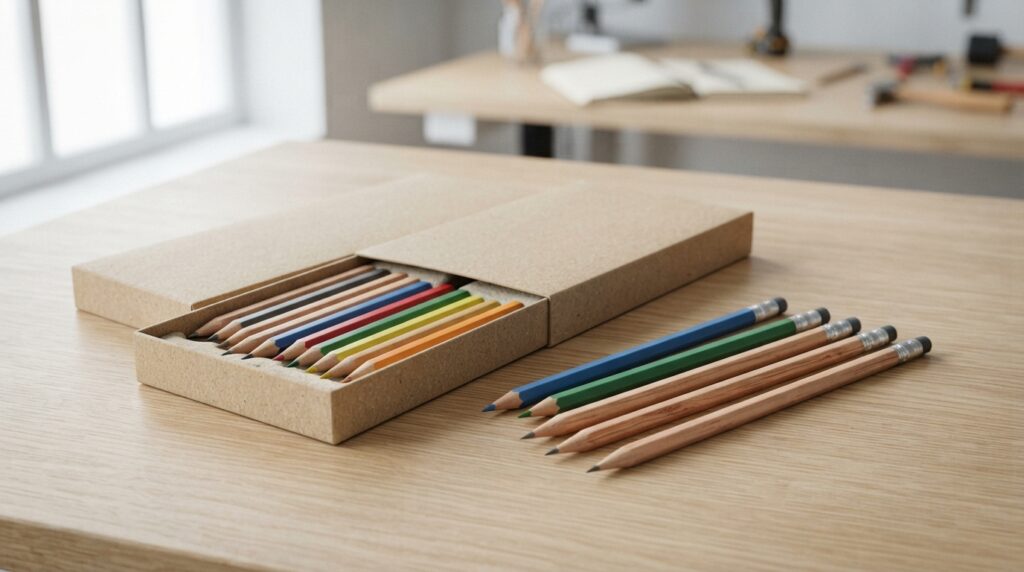
A single pencil is a tool; a set of six in a foil-stamped rigid box is a statement. For the **corporate pencils OEM** market, packaging is just as important as the pencils themselves. Factories offer various packaging solutions to suit different brand tiers:
| Packaging Type | Best For | Customization Level |
|---|---|---|
| Cardboard Slide Box | General Promotions | High (Full-color printing) |
| Tin Case | Artist or Executive Gifts | Medium (Embossing/Stamping) |
| Rigid “Jewelry” Box | Luxury Corporate Gifting | High (Felt inserts, ribbon pulls) |
| Eco-Friendly Kraft Tube | Sustainability Campaigns | Medium (Natural textures) |
The assembly of these sets often happens in a clean-room environment where pencils are manually or semi-automatically placed into inserts. This stage often includes the addition of accessories like premium sharpeners or branded erasers, creating a cohesive “desk set” experience.
Sustainability and Certification in OEM Manufacturing
In today’s corporate world, sustainability is a non-negotiable requirement. Most reputable **corporate pencils OEM** providers hold certifications like FSC (Forest Stewardship Council) or PEFC. These certifications guarantee that the wood used in the gift sets comes from responsibly managed forests that provide environmental, social, and economic benefits.
Furthermore, factories are increasingly moving toward water-based lacquers rather than solvent-based ones. This reduces the emission of Volatile Organic Compounds (VOCs), making the production process safer for workers and the final product safer for the end-user. For a corporation, being able to state that their gift sets are “carbon-neutral” or “sustainably sourced” adds significant value to the gesture.
The technical depth of this process is beautifully illustrated by Caran d’Ache’s craftsmanship, which emphasizes that even the pigments used in the colored lacquer must be lightfast and non-toxic. When a brand chooses a high-end OEM partner, they are tapping into this ecosystem of safety and responsibility.
The Logistics of Ordering Corporate Pencil Sets
For a business looking to start a **corporate pencils OEM** project, the timeline is a critical factor. Unlike buying off-the-shelf products, custom manufacturing typically takes 4 to 8 weeks. This accounts for:
- Prototyping: The factory creates a sample based on the brand’s PMS (Pantone Matching System) colors and logo files.
- Sourcing: Ensuring the specific wood and lead grades are in stock.
- Production Run: The actual 35-step fabrication process.
- Curing: Allowing lacquer and glue to fully stabilize before packaging.
- Shipping: Global logistics from the factory to the corporate headquarters.
Understanding these lead times is essential for marketing managers planning around product launches or annual galas. The complexity of the process means that “rush orders” are often difficult without compromising the quality of the multi-coat finish or the bond of the lead.
Why Pencils Remain the Ultimate Corporate Gift
In a world dominated by digital devices, the tactile nature of a high-quality pencil is a refreshing change. It suggests a return to focus, brainstorming, and “analog” creativity. When a factory produces a **corporate pencils OEM** set, they are creating more than a writing instrument; they are creating a durable good that stays on a client’s desk for months, if not years.
Every time the recipient sharpens the pencil, they experience the aroma of the cedar and the smoothness of the graphite—sensory cues that build a positive association with the brand. By choosing a manufacturer that understands the 35 steps of fabrication, the nuances of lead engineering, and the importance of sustainable sourcing, companies can ensure their corporate gift is a true reflection of their commitment to quality.
Whether it’s a traditional factory in Tennessee or a high-tech facility in Japan, the production of corporate pencil sets remains a fascinating intersection of nature and industry. By respecting the process, brands can turn a humble stick of wood and graphite into their most effective ambassador.
Related Reading
- Why Schools Order Pencils in Bulk With Custom Imprints
- How Factories Produce Multi-Purpose Office Pencil Sets
- Understanding Pencil Slat Tolerance in OEM Production
- Why Importers Need Full Traceability for Pencils
- Why Retail Chains Prefer Eco-Friendly Pencil Sets
- Why Buyers Prefer Packaging With Multi-Language Labels
- How Factories Ensure Coating Color Repeatability
- How Factories Produce Eco-Friendly Recycled Wood Pencils
Share This Post
Share on facebook
Share on twitter
Share on linkedin
