

No products in the cart.

Why European Retail Chains Prefer Consistent SKU Dimensions
- Mark Yang
- July 31, 2026
- 7:16 pm
- No Comments
Table of Contents
In the world of international stationery procurement, the humble pencil might seem like a simple commodity. However, for a European retail chain managing thousands of product lines across multiple borders, simplicity is a hard-won result of rigorous standardization. When a category manager at a major retailer like Carrefour, Tesco, or Lidl looks at a proposal for a new private-label line, they aren’t just looking at the quality of the cedar or the smoothness of the graphite; they are looking at the millimetres.
The preference for consistent **SKU dimensions pencils** among European retailers is not a matter of aesthetic pickiness. It is a strategic mandate driven by the unique physical constraints of the European retail landscape, the complexity of cross-border logistics, and the increasing reliance on automated supply chain technologies. In an environment where shelf space is at a premium and operational margins are under constant pressure, standardization is the primary tool for maintaining profitability.
The Physical Reality: Why European Shelf Space Dictates SKU Standards
One of the most significant factors influencing retail strategy in Europe is the physical size of the stores. Unlike the sprawling “big box” culture of the United States, European retail is characterized by high-density urban environments where every square centimetre of floor space must justify its existence. Historical data has shown that U.S. retail stores have historically been nearly double the size of their European counterparts, a trend that persists due to urban planning regulations and the prevalence of smaller, more frequent shopping trips in Europe.
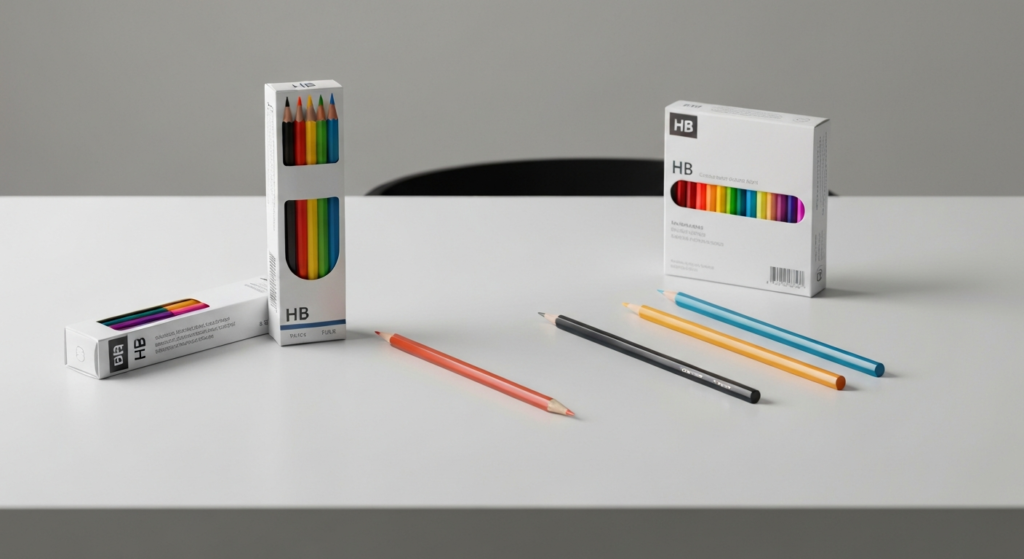
Because European stores are smaller, their planograms (the visual maps of where products are placed on shelves) are incredibly rigid. A pencil manufacturer who deviates from the standard **SKU dimensions pencils** by even 3 millimetres can cause a “cascade failure” in a shelf layout. If a box of 12 pencils is slightly too tall, it may not fit under the shelf above it; if it is too wide, it could push the adjacent product out of its designated “facings.” For a retailer operating 2,000 locations, this isn’t a minor annoyance—it’s a logistical nightmare that leads to messy shelves and lost revenue.
Visual Consistency as a Driver of Consumer Trust
Beyond the physical fit, there is the psychological impact of visual consistency. European consumers are navigating a fragmented market where they might encounter the same brand in a high-end department store in Paris and a discount convenience store in a rural village. Maintaining a unified brand image across these diverse formats is paramount to building long-term recognition and trust.
When a retail chain ensures that all **SKU dimensions pencils** are consistent within a category, it creates a sense of “visual calm” on the shelf. This professional appearance directly correlates with perceived value. As noted in industry research regarding visual consistency across retail locations, a disjointed customer journey—where products look different or are packaged inconsistently—can lead to brand dilution. For a retailer, a shelf where every pencil box aligns perfectly signals quality and organizational efficiency, which reassures the shopper.
Table 1: Comparison of US vs. European Retail Logistics for Stationery
| Feature | United States Retail | European Retail |
|---|---|---|
| Average Store Size | Large (High Square Footage) | Compact (Efficiency Focused) |
| Assortment Strategy | Broad (More SKU variety) | Curated (Focus on top-selling SKUs) |
| Shelf Depth | Deep (Allows for more stock behind) | Shallow (Requires frequent restocking) |
| Packaging Preference | Bulk/Value Packs | Standardized, Slim-line, Sustainable |
| Planogram Flexibility | High | Low (Millimetre precision required) |
The Economic Drivers: Profitability and Competitive Positioning
The European grocery and stationery sectors operate on razor-thin margins. According to S&P Global, the fundamental drivers of profitability for European food retailers are location, competitive positioning, and store size. In this context, “competitive positioning” is often defined by how efficiently a retailer can move product from a distribution centre to a shopping basket.
When a retailer mandates specific **SKU dimensions pencils**, they are essentially optimizing their “cube utilization.” This refers to how much of the shipping container, the pallet, and the shelf is filled with actual product versus “dead air.” If a pencil manufacturer uses non-standard packaging that leaves empty gaps in a shipping carton, the retailer is effectively paying to ship air. Over hundreds of thousands of units, these inefficiencies can erode the profitability of the entire stationery category. By enforcing consistent dimensions, retailers can maximize the density of their inventory, ensuring that every truckload and every shelf is as profitable as possible.
Automation and the Role of AI in Inventory Management
Modern European retail is no longer managed by hand-drawn charts; it is governed by sophisticated algorithms and automated warehouses. Automated picking systems and robotic shelf-stocking tools rely on precise data inputs. If the digital record for a product’s **SKU dimensions pencils** does not match the physical reality, the automation fails.
A report by McKinsey on the state of grocery retail in Europe highlights the increasing role of AI and digital integration. As retailers move toward “dark stores” (automated fulfillment centres for online orders), the need for standardized packaging becomes even more critical. A robot calibrated to pick a box of 175mm x 45mm x 15mm will fail or cause a jam if the box is suddenly 180mm long. Therefore, consistency isn’t just about the retail floor; it’s about the entire digital-physical ecosystem of modern commerce.
Supply Chain Resilience through European Manufacturing
In recent years, there has been a notable shift toward “near-shoring” or keeping the supply chain within the European continent. The advantages of manufacturing and managing the supply chain in Europe include shorter lead times, better quality control, and a reduced carbon footprint—all of which are high priorities for European consumers and regulators.
For a stationery manufacturer located within Europe, adhering to consistent **SKU dimensions pencils** is easier than for overseas suppliers. Local manufacturers can coordinate more closely with retailers to develop “shelf-ready packaging” (SRP). SRP allows store staff to place an entire carton of pencils onto the shelf in one movement, rather than stocking individual boxes. For this to work, the dimensions of the inner SKU must perfectly match the dimensions of the outer transit case, which in turn must fit the standardized shelf heights of European stores. This level of coordination is only possible when dimensions are treated as a rigid technical specification rather than a suggestion.
Table 2: Common Standardized Dimensions for Graphite Pencil SKUs
| SKU Type | Standard Dimensions (Approx) | Strategic Benefit |
|---|---|---|
| Individual Pencil (Loose) | 175mm Length x 7mm Diameter | Fits universal sharpeners and standard retail bins. |
| Cardboard Box (12-pack) | 180mm x 48mm x 16mm | Optimized for “facing” on shallow European shelves. |
| Blister Pack (3-5 pack) | 210mm x 60mm (Card size) | Standardized for Euro-hook hanging displays. |
| Metal Tin (24-pack) | 195mm x 185mm x 12mm | Stackable; fits premium “art station” planograms. |
Assortment Size and Consumer Decision Fatigue
The complexity of European retail also extends to consumer behavior. Research published in *ScienceDirect* suggests that consumers prefer smaller, more curated assortments in convenience store settings, which are prevalent across Europe. When a retailer limits the variety of pencils they carry to focus on the best-selling options, those options must be presented flawlessly.
Consistent **SKU dimensions pencils** allow a retailer to stock a “good, better, best” range without the shelf looking cluttered. For instance, a private-label “Value” pencil and a “Premium” brand-name pencil should ideally share similar packaging footprints. This allows the customer to compare the products side-by-side easily. If the packaging sizes vary wildly, the shelf becomes visually chaotic, increasing “cognitive load” for the shopper and potentially leading them to abandon the purchase entirely in favor of a simpler experience.
Manufacturing Challenges: How OEMs Meet These Demands
As a professional in the pencil manufacturing space, I understand that achieving these consistent dimensions is a feat of engineering. A pencil is not just a stick of wood; it is a composite of a graphite core, a wooden sheath (usually incense cedar or basswood), multiple layers of lacquer, and often a ferrule and eraser.
Each of these components must be manufactured to tight tolerances to ensure the final product meets the required **SKU dimensions pencils**. For example:
– **The Core:** If the graphite lead is slightly off-center, the wood may warp during the drying process, leading to a “banana” pencil that won’t fit into standardized slim-line packaging.
– **The Lacquer:** Even the thickness of the paint matters. In a high-precision pack of 12, an extra 0.1mm of lacquer on each pencil adds over a millimetre to the total width of the bundle, potentially causing the outer box to bulge.
– **The Packaging:** The cardboard used for the boxes must be of a specific “grammage” to ensure it doesn’t swell in humid warehouse conditions, which would change the SKU’s dimensions and disrupt automated picking arms.
Retailers favor manufacturers who can guarantee this level of precision. In the OEM (Original Equipment Manufacturer) world, a factory’s ability to maintain dimensional consistency across a production run of millions is often what wins a contract over a lower-priced competitor who cannot guarantee the same tolerances.
The “Small Format” Trend and Future-Proofing
The rise of the “Express” or “Local” store format in European cities has only intensified the demand for standardization. As large grocery chains move into smaller urban spaces, they are shrinking their stationery aisles. According to YouGov, there is a clear trend where large retailers are pivoting toward small-format stores to meet consumer needs for convenience and speed.
In these smaller stores, there is no room for error. A retailer might only have one “facing” available for a 12-pack of HB pencils. If the manufacturer changes the **SKU dimensions pencils** mid-season, the new stock might not fit the existing shelf hardware. This would require the retailer to send a technician to the store to adjust the shelving—an expense that far outweighs the profit from the pencils themselves. Consequently, retailers are increasingly loyal to suppliers who provide “stable” SKUs that do not change dimensions for years at a time.
Sustainability and the Dimension Equation
Finally, we must consider the impact of the European “Green Deal” and the push for sustainability. Retailers are under pressure to reduce plastic and excess packaging. This has led to a redesign of many stationery SKUs. However, even when moving from a plastic blister pack to a cardboard tuck-box, the mandate remains: the new, sustainable **SKU dimensions pencils** must ideally mimic the old dimensions to avoid disrupting the existing supply chain infrastructure.
Smart manufacturers are now designing “right-sized” packaging that eliminates plastic while maintaining the standard footprint required by European planograms. This allows the retailer to meet their sustainability goals without having to re-map their entire store layout or re-program their logistics software.
Conclusion: The Strategic Value of the Millimetre
For the European retail chain, consistency is the antidote to complexity. In a market defined by high costs, small spaces, and diverse consumer expectations, the ability to standardize a product as simple as a pencil is a competitive advantage.
When we talk about **SKU dimensions pencils**, we are talking about the language of the modern supply chain. It is a language that allows a manufacturer in Nuremberg to talk to a distribution center in Warsaw and a retail shelf in Madrid without a single word being spoken. For the professional content writer and the manufacturing expert alike, the lesson is clear: in the European market, the millimetre is just as important as the brand. By prioritizing consistent dimensions, retailers ensure that their operations remain lean, their shelves look professional, and their business remains profitable in an ever-shifting retail landscape.
Related Reading
- Why European Importers Request Pencil Stability Tests
- How Factories Ensure Multi-Pack Consistency
- Why Buyers Evaluate Pencil Weight Consistency
- Why Retail Chains Prefer Eco-Friendly Pencil Sets
- Why Retailers Choose Sustainable Pencil Packaging
- Understanding Pencil Slat Tolerance in OEM Production
- How Factories Achieve Perfect Pencil Barrel Symmetry
- Why Importers Need Full Traceability for Pencils
Share This Post
Share on facebook
Share on twitter
Share on linkedin
