

No products in the cart.

Why Retailers Choose Pre-Sharpened Packs for Convenience
- Mark Yang
- May 20, 2026
- 7:15 pm
- No Comments
Table of Contents
In the fast-paced world of retail, the concept of “convenience” has evolved from a simple location-based advantage to a sophisticated psychological and operational strategy. For stationery buyers and store managers, the choice of which products to stock often boils down to a single question: How quickly can the customer use this? This is exactly why **pre-sharpened retail pencils** have become a staple in convenience stores, airport kiosks, and urban pharmacies. When a consumer walks into a store looking for a writing instrument, they are rarely planning for next week; they are solving a problem for right now.
The transition from traditional unsharpened wood-case pencils to pre-sharpened packs reflects a broader shift in consumer behavior. Shoppers are increasingly looking for “ready-to-use” solutions that eliminate the need for secondary purchases, such as sharpeners. By stocking pencils that are already pointed and ready for the page, retailers are not just selling a product—they are selling a frictionless experience.
The “Mission-Based” Strategy for Stationery
To understand why **pre-sharpened retail pencils** dominate the convenience sector, we must look at the specific “missions” that drive shoppers into these stores. According to research from Globalpraxis, convenience store success is rooted in “mission-based targeting.” Unlike a supermarket where a shopper might buy in bulk for the month, a convenience store shopper is often on a “distress mission” or an “immediate-need mission.”
If a student realizes five minutes before an exam that they have no pencils, or if a contractor needs to mark measurements on a job site but lost their tool kit, they aren’t looking for a 24-pack of unsharpened pencils. They need a tool that works the moment they leave the register. Retailers who align their packaging and product format with these specific consumption patterns see higher turnover. Offering pre-sharpened formats, specifically in smaller bundles (2-packs or 4-packs), directly addresses the impulse nature of the channel.
The Psychological Power of the Price-Marked Pack (PMP)
For retailers, the decision to stock **pre-sharpened retail pencils** often goes hand-in-hand with the use of Price-Marked Packs (PMPs). In many regions, stationery items in convenience stores feature a pre-printed price on the packaging. This is more than just a convenience for the cashier; it is a powerful tool for building consumer trust.
Insights from DCS Manufacturing suggest that a third of shoppers view PMPs as a reassurance against being overcharged. In a convenience setting, where prices are often perceived to be higher than in big-box retailers, a clearly marked price on a pack of pencils eliminates “price anxiety.” It tells the customer that the price is “official” and fair.
Furthermore, Lumina Intelligence has tracked the relevance of PMPs for over a decade, finding that “trust” remains a top-three factor for convenience shoppers. When a customer sees a pack of **pre-sharpened retail pencils** with a clear price, the transparency of the value proposition makes the purchasing decision nearly instantaneous. They see the price, they see the product is ready to use, and they complete the transaction without hesitation.
Operational Efficiency and Grab-and-Go Success
From the retailer’s perspective, shelf space is the most valuable currency. Every square inch must generate a specific return on investment. The “grab-and-go” segment relies on maximum efficiency, both for the shopper and the store operations. As noted by CSNews, operational improvements like streamlined inventory management are critical to maintaining a competitive edge.
Pre-sharpened retail pencils contribute to this efficiency in several ways:
- Reduced Returns/Complaints: An unsharpened pencil requires a sharpener. If a store sells unsharpened pencils but doesn’t stock sharpeners, it creates a point of friction that can lead to customer dissatisfaction.
- Visual Appeal: A sharpened point is a visual cue of “readiness.” It looks more professional and functional on the shelf than a flat, wooden end.
- Higher Velocity: Because these packs solve an immediate problem, they tend to move faster than bulk stationery items, allowing for more frequent inventory refreshes and better cash flow.
Retailers who prioritize these ready-to-use formats are essentially optimizing their “convenience strategy” by making the customer journey as frictionless as possible. As the MIT Sloan Review points out, true convenience isn’t just about where you are; it’s about how much effort the customer has to exert. Eliminating the “sharpening step” is a micro-convenience that adds up to macro-loyalty.
Manufacturing Quality and the Retailer’s Reputation
For a retailer, the quality of a simple pencil can reflect on the store’s overall brand. From a manufacturing standpoint, **pre-sharpened retail pencils** are often produced with higher-quality graphite cores to ensure that the point doesn’t break during transit. When a factory sharpens a pencil, they use industrial-grade cutters that provide a perfectly centered point, which is often superior to what a consumer can achieve with a small handheld sharpener.
This manufacturing precision ensures that when the customer opens the pack, the pencil is ready for high-performance use. For retailers, this means fewer broken leads and fewer “dud” products on the shelf. In the stationery industry, “point strength” is a key metric, and pre-sharpened packs allow manufacturers to showcase their lead quality immediately.
The Importance of Labeling and Transparency
Modern consumers are more informed than ever, and they expect immediate access to product information. While nutritional transparency is a major trend in the food sector—as highlighted by Bollin Label—the same logic applies to non-food items like stationery.
When a shopper looks at a pack of **pre-sharpened retail pencils**, they are looking for specific cues:
- Is it a #2/HB lead (standard for tests)?
- Is it non-toxic?
- Is the wood sustainably sourced?
- Is it actually pre-sharpened?
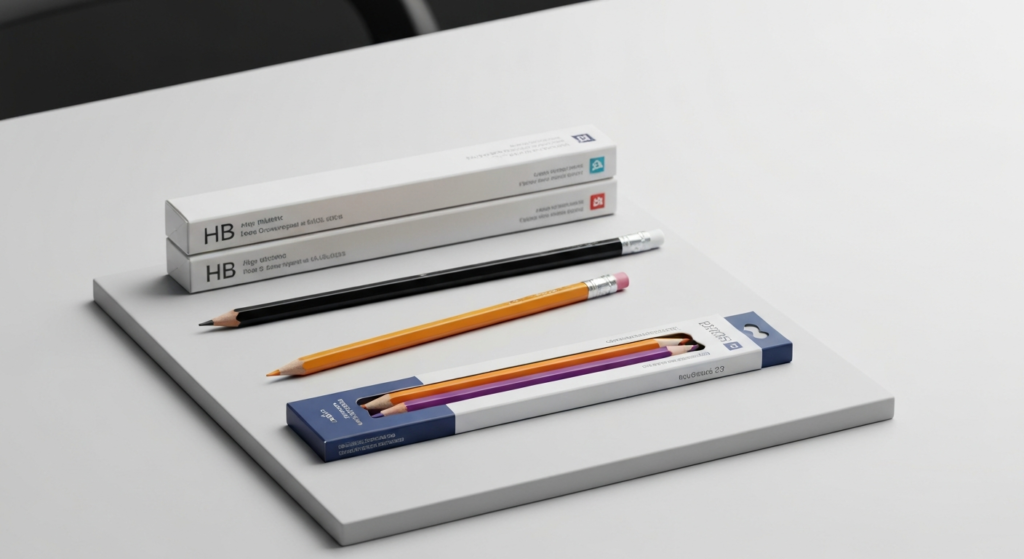
Effective packaging design for these pencils uses clear windows so the consumer can see the sharpened tips and bold icons that communicate “Ready to Write.” This functional communication mirrors the “transparency” trend seen in the grocery aisle. If the customer can’t tell at a glance that the pencil is ready to use, the convenience factor is lost.
Localized Assortment: Not Every Store Needs the Same Pack
One of the biggest mistakes a retailer can make is assuming a one-size-fits-all approach to stationery. Research published in ScienceDirect emphasizes that convenience stores must tailor their assortment size and allocation to local market conditions.
For example, a store located near a university may see a high demand for **pre-sharpened retail pencils** in 12-packs for students preparing for finals. Conversely, a store in a central business district might find that 2-packs or even single-unit pre-sharpened pencils with an eraser are the better sellers for professionals on the go. By analyzing local demographics, retailers can optimize their stock to ensure they are providing the *right* kind of convenience for their specific community.
Retailer Benefits Comparison Table
To better understand the strategic advantage, let’s compare the two primary formats found in the retail stationery market:
| Feature | Pre-Sharpened Retail Packs | Standard Unsharpened Packs |
|---|---|---|
| Target Shopper | On-the-go, immediate need, “distress” buyer. | Planned purchase, home/office stock-up. |
| Perceived Value | High (Value of time and readiness). | Medium (Focus on unit price). |
| Cross-Selling | Standalone item (requires nothing else). | Requires a sharpener (lost sale if not in stock). |
| Shelf Velocity | Higher in convenience/transit hubs. | Higher in big-box/office supply stores. |
| Trust Factor | High, especially when paired with PMPs. | Standard. |
Balancing Profit Margins with Consumer Trust
A common debate among retailers is whether to prioritize higher-margin unsharpened pencils or the higher-velocity **pre-sharpened retail pencils**. As discussed in Better Retailing, the implementation of Price-Marked Packs can sometimes tighten margins, but the trade-off is often worth it due to increased volume and shopper loyalty.
In the case of pre-sharpened pencils, the “manufacturing value-add” allows for a slightly higher price point per unit compared to bulk unsharpened pencils. Consumers are willing to pay a premium for the fact that the pencil is ready to use. For the retailer, this means that even if the percentage margin is slightly lower, the absolute profit per transaction and the frequency of those transactions often lead to better category performance.
The Future of “Convenient” Stationery
The trend toward **pre-sharpened retail pencils** is not just a passing phase; it is part of a long-term evolution in how we view “work tools.” As the boundary between “office,” “home,” and “commute” continues to blur, the demand for portable, ready-to-use stationery will only grow.
Retailers are also starting to look at more sustainable ways to offer this convenience. We are seeing a rise in FSC-certified wood and recycled materials being used in pre-sharpened formats. This allows the retailer to offer both convenience and ethical peace of mind—two factors that are increasingly important to the modern shopper.
According to Talking Retail, the future of category management in convenience lies in “eliminating ambiguity.” Whether it’s through clear pricing (PMPs) or clear product utility (pre-sharpened tips), the goal is to make the shopper’s decision-making process as fast as possible.
Why the Move to Pre-Sharpened Makes Sense Now
We live in a “just-in-time” economy. From food delivery to streaming services, consumers are conditioned to expect immediate results. When this mindset is applied to the stationery aisle, the traditional unsharpened pencil starts to look like a “half-finished” product.
For the retailer, stocking **pre-sharpened retail pencils** is a low-risk, high-reward strategy. It aligns with the “mission-based” shopping habits of the most frequent convenience store visitors. It builds trust through transparent packaging and pricing. Most importantly, it fulfills the core promise of the convenience channel: making life easier for the customer, one sharp point at a time.
By focusing on these “ready-to-write” solutions, retailers can ensure their stationery aisle remains relevant in an increasingly digital world. A pencil might be an ancient technology, but its delivery and format can be as modern as any app—if it’s designed with the user’s immediate needs in mind.
Related Reading
- Why Retail Chains Prefer Ready-to-Shelf Pencil Packaging
- Why Pencil Set Packaging Affects Retail Sales
- Why Retail Chains Prefer Product Barcode Stickers
- Understanding Pencil Packaging Material Choices
- How Factories Produce Multi-Pack Pencil Sets
- Why European Retailers Need REACH-Compliant Pencils
- How European Retailers Evaluate Pencil Supplier Reliability
- Why Pencil Barrel Straightness Matters for Sharpening
Share This Post
Share on facebook
Share on twitter
Share on linkedin
