

No products in the cart.

Why Retail Chains Prefer Carton-Ready Bulk Packaging
- Mark Yang
- October 20, 2026
- 6:15 pm
Table of Contents
In the competitive world of stationery retail, the “back-to-school” season represents a high-stakes logistical marathon. For retail managers, the efficiency with which they can move thousands of units of graphite and colored pencils from the delivery truck to the shelf determines their success. This is precisely why major retail chains are increasingly moving away from traditional bulk shipments in favor of carton-ready pencils. Retail-ready packaging (RRP) is no longer a luxury; it is a strategic requirement for any pencil manufacturer looking to secure long-term contracts with global retailers.
Defining the Shift: What is Carton-Ready Packaging?
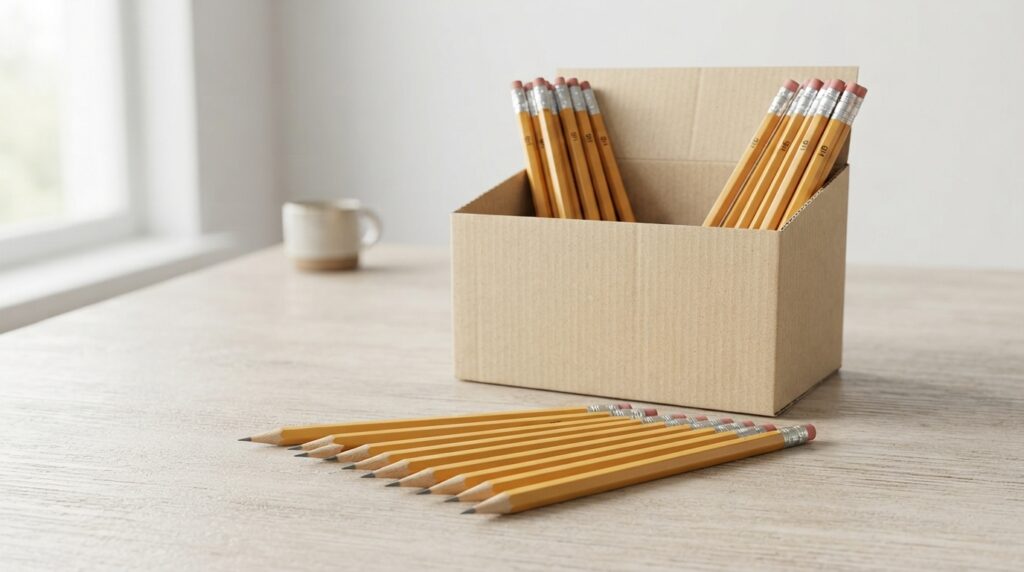
At its core, carton-ready packaging—often referred to as Shelf-Ready Packaging (SRP)—is a design philosophy where the shipping container also serves as the retail display unit. For pencil manufacturers, this means moving beyond the standard 144-count “gross” box shoved into a generic brown shipping carton. Instead, it involves engineering a corrugated box that arrives with pre-perforated lines, allowing a store clerk to “tear away” the top and place the remaining tray directly on the shelf.
According to industry insights from PakFactory, high-quality RRP must satisfy the “Five Easies”: easy to identify, easy to open, easy to shelf, easy to shop, and easy to dispose of. In the context of stationery, this means a carton of carton-ready pencils must be clearly marked on all sides with the lead grade (HB, 2B, etc.) and quantity, while the structural design ensures that the pencils don’t spill out when the perforated top is removed.
This transition reflects a fundamental change in how retail chains view their “backroom” operations. By eliminating the need to take individual packs of pencils out of a shipping box and line them up one by one on a wire rack, retailers can reclaim hundreds of man-hours across their regional networks.
Solving the Labor Shortage Through Packaging Design
One of the most pressing challenges in modern retail is the rising cost and scarcity of labor. When a store receives a shipment of bulk stationery, the time spent unpacking and merchandising can be staggering. Conventional packaging requires clerks to open a box, remove plastic wrap, and manually arrange items to ensure the brand logo is facing the consumer. Carton-ready pencils eliminate these steps by arriving pre-aligned and pre-faced.
Research from the Packaging Corporation of America suggests that RRP can significantly reduce in-store labor costs while simultaneously reducing the occurrence of “out-of-stock” scenarios. If it takes only five seconds to replace an empty pencil tray with a new carton-ready unit, the shelf stays full. If it takes five minutes to restock individual units, the task is often delayed, leading to empty shelves and lost sales during peak hours.
For pencil manufacturers, this means the packaging is as much a part of the product as the graphite itself. A retail buyer is more likely to choose a supplier who provides carton-ready pencils because it directly improves the store’s operational bottom line. The packaging becomes a tool for efficiency, allowing fewer employees to manage larger inventory volumes without sacrificing store appearance.
Supply Chain Efficiency and Transit Protection
The journey of a pencil from a manufacturing plant in Asia or Europe to a retail shelf in North America is fraught with opportunities for damage. Graphite is brittle, and the wooden casings of pencils can chip or dent if subjected to excessive pressure. Standard bulk shipping often results in “crush” damage when boxes are stacked too high in shipping containers.
Carton-ready pencils are typically designed with reinforced corrugated walls to serve a dual purpose: surviving the rigors of global logistics and maintaining their shape on the shelf. As noted by Atlantic Packaging, RRP optimizes the entire logistical flow by standardizing dimensions. This standardization allows for better pallet utilization, reducing the “air” shipped in containers and lowering the carbon footprint per unit.
When a manufacturer ships carton-ready pencils, the structural integrity of the outer carton protects the inner “display” tray. This reduces the rate of returns due to damaged goods. For a retail chain, receiving a shipment that is ready for the floor without the need for additional “re-packing” or quality checks saves significant time in the distribution center.
The “Silent Salesman”: Marketing at the Point of Purchase
In the stationery aisle, visual noise is a major hurdle. Dozens of brands compete for the attention of parents and students. Carton-ready pencils act as a “silent salesman” by providing an additional surface for high-impact branding. While the individual pencil box might be small, the carton-ready tray offers a larger “billboard” area on the front and sides of the tray.
This is where custom retail-ready cartons and point-of-purchase (POP) displays become invaluable. Industry experts at Great Northern Packaging emphasize that these displays influence customer perception at the “moment of truth”—the few seconds a shopper spends looking at the shelf. A well-designed carton for carton-ready pencils can communicate brand values, such as “eco-friendly cedar wood” or “break-resistant lead,” more effectively than a crowded shelf of loose items.
Furthermore, these cartons ensure that the pencils are always “front-facing.” In traditional bulk shelving, as customers pick up packs, the remaining stock gets pushed to the back, making the shelf look messy and depleted. With carton-ready pencils, the tray keeps the product contained and visible, maintaining a premium brand image even when the inventory is half-sold.
A Comparative Look: Standard Bulk vs. Carton-Ready Packaging
To understand why retailers are making this demand, it helps to look at the metrics that matter to a floor manager.
| Feature | Standard Bulk Packaging | Carton-Ready (RRP) |
|---|---|---|
| Stocking Time | High (Individual placement) | Minimal (Drop-in-place) |
| Brand Visibility | Limited to small product facings | Enhanced by tray graphics |
| Shelf Maintenance | Frequent “facing” required | Self-contained organization |
| Waste Management | Multiple plastic wraps & boxes | Single, recyclable corrugated tray |
| Product Protection | Low (High risk of breakage) | High (Reinforced tray walls) |
As the table illustrates, carton-ready pencils offer a superior experience across every retail KPI. The reduction in stocking time alone often justifies the slightly higher manufacturing cost of the specialized corrugated material.
The Counter-Argument: When is RRP Not the Best Choice?
While the benefits are numerous, it is important to acknowledge that carton-ready solutions are not a universal panacea. Some high-end stationery boutiques or traditional supermarkets avoid shelf-ready packaging to maintain a specific “curated” aesthetic. A discussion on Quora highlights that premium retailers often feel that cardboard trays look “cheap” or “industrial,” preferring to display pencils in glass jars or custom wooden bins.
For these retailers, the visual merchandising strategy is based on browsing and sensory experience. In such cases, carton-ready pencils might be seen as an obstacle rather than an advantage. However, for “Big Box” retailers and discount chains like Walmart, Target, or Aldi, the “industrial” look of RRP is a non-issue compared to the massive savings in labor and the consistency of the display.
Manufacturers must therefore be flexible. A versatile pencil factory will offer both traditional bulk packing for boutique clients and sophisticated carton-ready pencils for mass-market retailers. Understanding the target audience’s merchandising philosophy is key to offering the right packaging solution.
Strengthening Retailer Relationships
In the B2B world of stationery manufacturing, the goal is to become a “preferred vendor.” This status is achieved not just by producing a high-quality pencil, but by being easy to do business with. By proactively offering carton-ready pencils, a manufacturer demonstrates that they understand the retailer’s pain points.
The blog Vdriven points out that RRP is a critical element in fostering robust retailer relationships. When a manufacturer provides products that are “easy to sell,” they help the retail buyer hit their internal targets for category growth and labor efficiency. Over time, this builds a level of trust that can protect a manufacturer from being undercut by a cheaper competitor who only offers standard, labor-intensive packaging.
Furthermore, carton-ready pencils allow for better inventory control. Because the pencils are grouped in standardized trays, it is easier for store staff to conduct quick visual inventory counts. This leads to more accurate ordering and fewer “emergency” stockouts, ensuring that the brand is always available when the consumer walks down the aisle.
Sustainability and the Future of Stationery Packaging
The modern consumer is increasingly sensitive to plastic waste. Traditional pencil packaging often involves “blister packs”—plastic bubbles glued to cardboard backing. These are difficult to recycle and are often viewed as environmental nuisances. Carton-ready pencils provide an elegant solution to this problem by utilizing cardboard and corrugated paper.
By shipping pencils in a reinforced paper tray that serves as the display, manufacturers can often eliminate the need for individual plastic hang-tags or shrink-wrap. This aligns with the sustainability goals of major retail chains, many of which have committed to reducing single-use plastics in their supply chains. Carton-ready pencils made from FSC-certified paper materials appeal to the eco-conscious student and the corporate sustainability officer alike.
Looking forward, we can expect to see even more innovation in this space. “Smart” cartons with integrated QR codes for inventory tracking, or “modular” RRP that can be resized for different shelf depths, are already in development. As retail becomes more automated, the packaging will need to be even more standardized to accommodate robotic stocking systems.
Manufacturing Considerations for Carton-Ready Success
For a pencil factory, moving to carton-ready pencils requires an investment in packaging machinery. The “tear-away” perforations must be precise; if they are too strong, the clerk will rip the box and ruin the display. If they are too weak, the box will fall apart during shipping. Finding the “Goldilocks” zone of perforation strength is a technical challenge that requires high-quality die-cutting equipment.
Additionally, the printing quality on the carton must be top-tier. Since the shipping box is now the retail display, the graphics must be crisp and the colors must match the brand’s identity perfectly. This often necessitates a move from simple flexographic printing to high-resolution offset or digital printing on the corrugated liner.
Despite these challenges, the ROI on carton-ready pencils is clear. By investing in better packaging, manufacturers reduce their waste, lower their shipping risks, and most importantly, make their products the favorite choice for retail managers. In an industry where the product itself (the pencil) has remained relatively unchanged for decades, the packaging is the new frontier for innovation and competitive advantage.
Conclusion
The preference for carton-ready pencils among retail chains is a logical response to the pressures of modern commerce. By streamlining the path from the factory to the checkout counter, RRP solves critical issues of labor, logistics, and brand visibility. While a few high-end boutiques may still prefer the manual touch of loose displays, the vast majority of the stationery market is moving toward a future where the carton is just as important as the pencil it holds.
For manufacturers, the message is simple: adapt or be left behind. Embracing carton-ready designs is no longer about following a trend; it’s about providing a comprehensive service that helps retailers sell more products with less effort. In the end, the “perfect” pencil is the one that is easy to find, easy to buy, and—most importantly for the retailer—easy to put on the shelf.
Related Reading
- Why Retail Chains Avoid Non-Compliant Pencil Packaging
- Why Importers Should Check Pencil Packaging Barcode Quality
- Why Retail Packs Require Consistent Color Labelling
- Why Schools Order Pencils in Bulk With Custom Imprints
- Why European Retail Chains Prefer Consistent SKU Dimensions
- Why Importers Need Full Traceability for Pencils
- Why Retail Chains Prefer Eco-Friendly Pencil Sets
Share This Post
Share on facebook
Share on twitter
Share on linkedin
