

No products in the cart.

Why Buyers Prefer Packaging With Multi-Language Labels
- Mark Yang
- June 22, 2026
- 7:15 pm
- No Comments
Table of Contents
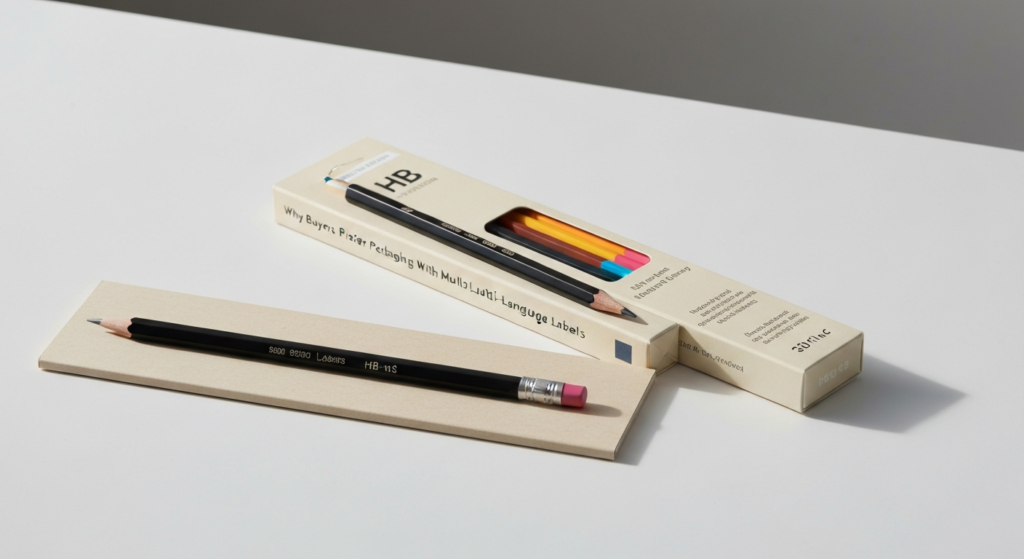
In the competitive landscape of the global stationery market, a pencil is rarely just a pencil. For professional buyers, distributors, and retail category managers, the product is a combination of lead quality, wood casing, and, perhaps most importantly, the communication on the box. As brands expand beyond their domestic borders, the demand for multilingual packaging pencils has transitioned from a niche requirement to a strategic necessity.
Whether you are a procurement officer for a multinational retail chain or a distributor looking to penetrate the European or Southeast Asian markets, understanding why multi-language labels are preferred is essential. This preference isn’t merely about translation; it is a sophisticated approach to logistics, psychology, and brand equity. When a customer in a bookstore in Berlin or a supermarket in Mexico City picks up a set of drawing pencils, the ability to read the safety warnings, wood type, and graphite grade in their native tongue creates an immediate bridge of trust.
This article explores the multi-faceted reasons why buyers are shifting toward multilingual solutions, the manufacturing complexities involved, and how smart packaging design can drastically improve your bottom line.
Strategic SKU Consolidation and Inventory Agility
One of the most immediate benefits for high-volume buyers is the reduction of Stock Keeping Units (SKUs). In traditional manufacturing, a brand might produce one version of a 12-pack of colored pencils for the UK, another for France, and a third for Germany. This leads to what supply chain experts call “SKU proliferation,” which complicates warehouse management and increases holding costs.
By utilizing multilingual packaging pencils, a brand can consolidate these regional variations into a single, universal SKU. This means that a single production run can serve an entire continent. When inventory is consolidated, the risk of having a surplus of “French-only” boxes while facing a shortage of “German-only” boxes is eliminated. This operational agility allows distributors to move stock across borders as demand fluctuates, ensuring that capital isn’t tied up in slow-moving, language-specific inventory.
Furthermore, this consolidation facilitates much lower minimum order quantities (MOQs) for specific regions. Instead of needing to order 5,000 units specifically for a small market like Portugal, a buyer can order 20,000 units of a multilingual pack that serves Portugal, Spain, Italy, and France combined. For a deeper dive into how this affects global sales strategy, inventory optimization through multi-country packaging provides an excellent framework for understanding the economic gains.
The Psychology of Consumer Trust and Quality Perception
From a consumer behavior perspective, language is a powerful proxy for quality and safety. Research has shown that consumers are more likely to engage with and purchase products that provide information in their native language. This is particularly true for stationery products like pencils, which often carry safety certifications (like EN71 or ASTM D-4236) and specific technical details regarding lead hardness or pigment concentration.
When a buyer chooses multilingual packaging pencils, they are investing in consumer confidence. A study cited by ResearchGate highlights that the language on a label significantly impacts how a user evaluates the product’s quality and even its “sensory” attributes. If a professional artist can read the technical specifications of a 6B graphite pencil in a language they fully understand, their perception of the brand’s expertise increases.
This psychological connection is even more profound in the “souvenir” and travel retail markets. Travelers are often drawn to products that feel localized yet international. Packaging that speaks multiple languages suggests a brand is a “world citizen,” making it a more attractive gift or souvenir. Industry insights from Bizongo’s analysis of language-specific packaging suggest that this tailored approach can drive impulse purchases in niche demographics that single-language boxes might miss.
Navigating Global Regulatory Landscapes
For the professional buyer, legal compliance is a non-negotiable priority. Different regions have strict mandates regarding what information must appear on consumer goods. In the EU, for example, certain safety warnings must be present in the official language of the member state where the product is sold. Failure to comply can lead to shipment seizures, heavy fines, and brand damage.
Designing multilingual packaging pencils ensures that these regulatory hurdles are cleared simultaneously across multiple jurisdictions. A well-designed pencil tin or cardboard box will include mandatory warnings (such as “choking hazard” or “not suitable for children under 3”) in five or six languages. This “pre-compliance” makes the product instantly exportable to dozens of countries without the need for relabeling or over-stickering, which is both costly and aesthetically unappealing.
Moreover, including multiple languages demonstrates a commitment to inclusivity. In the healthcare and education sectors, providing information in various languages is seen as a sign of respect and accessibility. This ethical branding can differentiate a pencil manufacturer in a crowded market where “price-only” competition is a race to the bottom.
The Design Challenge: Managing Space and Readability
One of the primary reasons buyers might hesitate to adopt multi-language labels is the fear of “cluttered” design. Pencils, especially individual blister packs or small 12-piece sets, have limited surface area. Fitting English, French, Spanish, German, and perhaps a sixth language like Arabic or Chinese requires a masterclass in typography and layout.
Successful multilingual packaging pencils often employ “language clustering.” This technique involves grouping information logically so that the eye can easily find the desired language. Manufacturers often use icons—such as a small pencil tip icon next to the “HB” designation—to reduce the amount of text needed. This visual shorthand transcends language barriers and saves precious space on the back of the box.
According to design experts, the key is to prioritize information hierarchy. The brand name and the primary product description (e.g., “Professional Sketching Pencils”) might be in a larger font in two or three dominant languages, while the more technical data and legal fine print are clustered in smaller, but still legible, blocks. For practical strategies on how to execute this, the guide on clustering languages on packaging offers four distinct methods to maintain readability without sacrificing aesthetic appeal.
Manufacturing Insights: Cost vs. Benefit
While the benefits are clear, buyers must also be aware of the manufacturing realities. Implementing multilingual packaging pencils can initially increase the complexity of the pre-press and proofing stages. Each language must be translated and localized—not just by a machine, but by a professional who understands the specific terminology of the stationery industry. For example, the word for “lead” in a pencil context is different from the metal “lead” in many languages.
However, these upfront costs are usually offset by the long-term savings in printing plates and setup times. In the world of lithographic printing, the “setup” or “make-ready” time is a significant portion of the cost. If you print 50,000 copies of one multilingual box, you pay the setup fee once. If you print 10,000 copies of five different boxes, you pay that fee five times.
| Feature | Single-Language Packaging | Multilingual Packaging |
|---|---|---|
| Inventory Management | High complexity; multiple SKUs per region. | Low complexity; one SKU for multiple regions. |
| Regulatory Compliance | Must be checked per country; high risk of error. | Broad compliance built-in; easier market entry. |
| Unit Cost (Volume) | Higher per-unit cost due to smaller runs. | Lower per-unit cost due to bulk printing. |
| Brand Perception | Local feel, but may seem “small-scale.” | International, professional, and inclusive feel. |
Localization: Moving Beyond Literal Translation
The most common pitfall in creating multilingual packaging pencils is “lazy translation.” Professional buyers should look for manufacturers who understand localization—the process of adapting the message to the cultural and social context of the target market.
For example, the way “graphite” or “charcoal” is described in Japan might involve different nuances than in the United States. Localization also involves adjusting measurements (cm vs. inches) and ensuring that color names resonate with local naming conventions. In the pencil industry, where precision is a selling point, a mistranslated lead grade or a clumsy description of the wood source (such as “California Cedar”) can immediately alienate a sophisticated buyer.
Expert localization builds a bridge of rapport. It tells the customer, “We didn’t just translate this; we understand your market.” This level of detail is what separates a premium brand from a generic one. When your packaging speaks the customer’s language fluently, the product inside—the pencil itself—is perceived as being of higher craftsmanship.
The Future Trend: Smart Packaging and QR Integration
As we look toward the future of multilingual packaging pencils, the integration of technology is bridging the gap between limited physical space and the need for infinite information. Many forward-thinking buyers are now requesting the inclusion of QR codes on the packaging.
A single QR code can lead to a localized landing page that provides detailed product information in 20 or 30 different languages, including video tutorials on pencil sharpening techniques or downloadable coloring templates. This “phygital” (physical + digital) approach allows the physical packaging to remain clean and minimalist while still providing the deep linguistic support that global consumers demand.
This trend is particularly relevant for high-end artist pencils. An artist in South Korea might want to know the lightfastness rating of a specific pigment in a way that is too detailed for the back of a small tin. By scanning a code, they can access a full PDF data sheet in Korean. This level of service builds long-term brand loyalty that transcends a simple one-time purchase.
Conclusion: The Competitive Advantage of Multilingual Labels
For the stationery buyer, the transition to multilingual packaging pencils is a strategic move that pays dividends across the entire supply chain. It simplifies logistics through SKU consolidation, ensures compliance with diverse global regulations, and taps into the deep-seated psychological preference for native-language communication.
While the design and localization process requires meticulous attention to detail, the result is a product that is more versatile, more trustworthy, and ultimately more profitable. In a world where the consumer is increasingly globalized yet more appreciative of localized attention, your packaging is your first and most important salesperson. By choosing a multilingual approach, you aren’t just selling a tool for writing or drawing—you are speaking the language of your customer, wherever they may be.
Related Reading
- Why Retailers Choose Sustainable Pencil Packaging
- Understanding Pencil Packaging Material Choices
- Why Retail Chains Prefer Ready-to-Shelf Pencil Packaging
- How Factories Reduce Pencil Chipping During Packaging
- Why Retail Chains Prefer Product Barcode Stickers
- Why Pencil Logos Require High-Precision Registration
- Why Pencil Branding Requires High-Precision Printing
- How Factories Ensure Multi-Pack Consistency
Share This Post
Share on facebook
Share on twitter
Share on linkedin
