

No products in the cart.

Why Importers Should Check Pencil Packaging Barcode Quality
- Mark Yang
- October 3, 2026
- 7:15 pm
Table of Contents
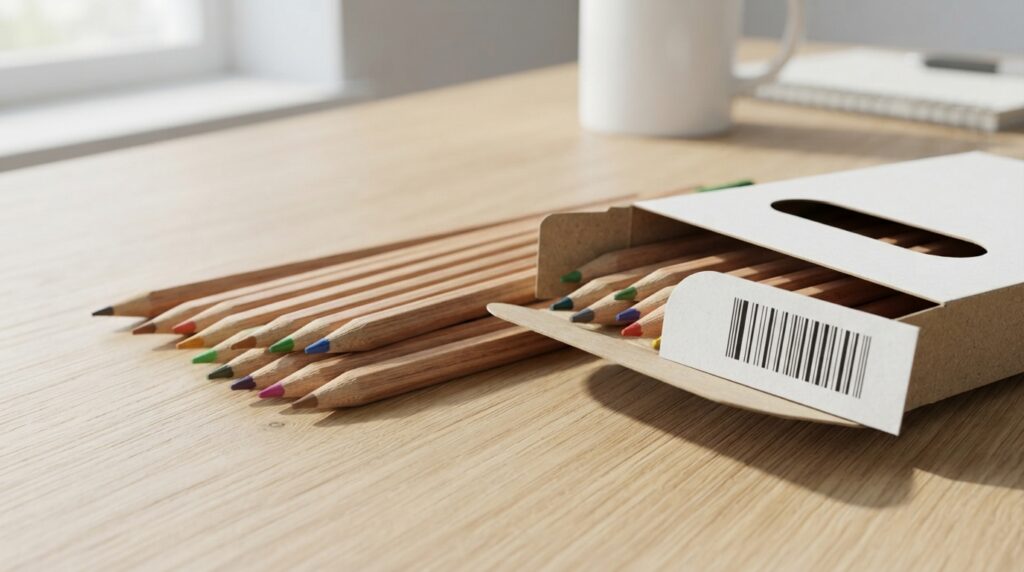
In the global stationery market, the difference between a successful product launch and a logistical nightmare often comes down to a few square centimeters of ink on a cardboard box. For importers bringing in massive shipments of graphite, colored, or mechanical pencils, the focus is usually on lead grade, wood quality, and lacquer finish. However, a frequently overlooked element that can stall an entire supply chain is the barcode. Ensuring barcode quality pencils are delivered to your warehouse is not just a technicality; it is a fundamental requirement for modern retail and distribution.
When a barcode fails to scan at a major distribution center or a retail point-of-sale, the repercussions are immediate and expensive. For the importer, this could mean rejected shipments, heavy financial penalties known as “chargebacks,” and the immense cost of re-labeling thousands of individual units. Understanding why barcode quality is a critical quality control (QC) metric allows importers to safeguard their margins and maintain strong relationships with big-box retailers.
This article explores the technical, logistical, and financial reasons why barcode verification must be a non-negotiable part of your pencil manufacturing and importing process. We will look at industry standards, common printing pitfalls in stationery packaging, and the strategic benefits of proactive inspection.
The Financial Impact of Barcode Failure in the Supply Chain
The primary reason importers must prioritize barcode quality pencils is the sheer cost of failure. In the modern “Just-in-Time” logistics environment, speed is everything. Automated warehouses rely on high-speed scanners to sort, track, and route products. If a barcode on a master carton or an individual pencil tin is unreadable, the automation stops. According to industry insights from Cognex, barcode failures lead to significant disruptions, including production line slowdowns and expensive reprints, which are foundational threats to operational fluidity.
For an importer, a “no-scan” event at a retailer like Walmart, Target, or Amazon can trigger a cascade of fees. These retailers often have strict vendor compliance manuals that dictate exactly how a barcode should perform. A single batch of poorly printed barcodes can result in “administrative fees” per unit or the total rejection of the container. When you consider the low unit margin of a standard pencil, these penalties can quickly turn a profitable shipment into a net loss.
Furthermore, the cost of “re-working” a shipment is astronomical. If 50,000 sets of colored pencils arrive with illegible barcodes, you must pay for labor to unpack, re-label, and repack each item. This process often costs more than the original manufacturing of the packaging itself, not to mention the missed delivery windows and damaged reputation with your client.
Beyond the “Beep”: Understanding Barcode Verification vs. Scanning
A common mistake many importers make is assuming that if a barcode scans with a smartphone or a basic handheld scanner at the factory, it is “good.” This is a dangerous misconception. Simple scanners are designed to be “aggressive,” meaning they try their best to read even poor-quality codes. However, the high-speed industrial scanners used in distribution centers are much less forgiving. They require barcodes to meet specific ANSI/ISO standards to ensure they can be read at high speeds from various angles.
To guarantee barcode quality pencils, manufacturers should use barcode verifiers, not just scanners. As noted by Certified Labeling Solutions, a simple test scan is insufficient to determine performance across diverse environments. Verification involves grading the barcode from A to F based on parameters like symbol contrast, modulation, and edge determination. An “A” grade barcode is perfect, while a “D” grade might scan in a quiet office but fail miserably on a vibrating conveyor belt under harsh LED lighting.
For pencil importers, the packaging often involves different substrates—glossy cardstock, tin, or even plastic shrink-wrap. Each of these materials reflects light differently. A barcode that looks crisp on a matte paper sleeve might suffer from “dead zones” or “hot spots” when printed on a metallic pencil tin. Professional verification ensures that the contrast between the bars and spaces is sufficient for industrial-grade sensors.
Common Barcode Issues in Pencil Packaging
Pencil packaging presents unique challenges for barcode quality pencils. Because pencils are often sold in slim, rectangular boxes or cylindrical tubes, the physical geometry of the package can interfere with the scanner’s line of sight. Here are the most common issues found in the stationery industry:
- Truncation: To save space on a slim box of 12 pencils, designers sometimes shorten the height of the barcode. While it may look aesthetic, truncating a barcode reduces the “scan window,” making it much harder for high-speed omnidirectional scanners to capture the data.
- Quiet Zone Infringement: Every barcode requires a “quiet zone”—a clear space of white at the beginning and end of the bars. In the crowded design of a colored pencil set, artwork or text often creeps into this zone, rendering the code unreadable.
- Ink Bleed and Spread: On lower-quality recycled cardboard often used for budget pencils, the ink can “bleed” into the fibers. This causes the black bars to widen and the white spaces to narrow, changing the data encoded in the symbol.
- Color Choice: While it might be tempting to print a barcode in dark green or blue to match the brand’s aesthetic, scanners rely on red-light contrast. Traditional black bars on a white background are the gold standard. Red bars, for instance, are invisible to many scanners.
By identifying these issues during the pre-production sample phase, importers can provide corrective feedback to the factory before mass production begins, saving weeks of delays later in the cycle.
Standardization and Positioning: The GS1 Perspective
Adhering to global standards is the only way to ensure your products move seamlessly across borders. The authority on this, GS1, emphasizes that barcode integrity is a combination of symbol type, size, and placement. For pencils, the placement is particularly tricky. If a barcode is placed too close to a corner or a seam of the box, the folding process might distort the bars.
Positioning also affects how the product is handled in a retail environment. A barcode placed on the bottom of a pencil tin is standard, but if it is placed on a curved edge, the “ladder” or “picket fence” orientation of the bars becomes critical. If the bars are parallel to the curve, the scanner might see them as varying in width due to the perspective. If they are perpendicular, the scan is much more reliable.
Maintaining barcode quality pencils requires a deep understanding of how the product will be shelved. Will it be hanging on a peg hook? Will it be stacked flat? The barcode must be accessible without the retail staff or the consumer having to tear the packaging. GS1 guidelines provide the technical roadmap to ensure that whether your pencils are sold in a boutique in Paris or a supermarket in New York, the code scans the first time, every time.
The Importer’s Checklist for Packaging Quality Control
Importers cannot afford to leave barcode quality to chance. It must be a dedicated step in the Quality Control (QC) checklist. Expert resources from InTouch Quality suggest that barcode legibility is one of the five essential checks no importer should skip. A failure here is a direct precursor to shipping delays and financial penalties.
When inspecting a shipment of pencils, the QC agent should perform the following:
| Check Category | Required Action | Success Criteria |
|---|---|---|
| Visual Integrity | Inspect for smudging, fading, or ink voids. | No visible defects; sharp edges on all bars. |
| Data Accuracy | Verify the encoded number against the SKU list. | The scanned number matches the human-readable text. |
| Quiet Zones | Measure the white space on both sides of the code. | Minimum of 3.63mm (for standard EAN/UPC) of clear space. |
| Placement | Check distance from edges, folds, and seams. | At least 8mm from any edge; not obscured by tape or wrap. |
| Scan Consistency | Test 10 units from different cartons using a verifier. | Consistent ANSI/ISO Grade ‘C’ or higher. |
By implementing this structured approach, you move from a reactive “fixing problems” mindset to a proactive “preventing errors” strategy. This is especially important when working with new suppliers who may not be familiar with the strict requirements of Western retail chains.
Strategic Advantage: Why Quality Inspection is an Investment
Many pencil manufacturers view barcode inspection as an added expense—a “nice to have” that takes time away from production. However, as TSME argues, these systems are a strategic investment. Validating barcode quality pencils before they leave the factory floor eliminates the risk of retailer chargebacks and enhances the brand’s reputation for reliability.
For an importer, being known for high-quality, “retail-ready” packaging is a competitive advantage. Retailers prefer working with vendors whose products “just work.” If your pencil shipments always flow smoothly through their automated systems, you become a preferred supplier. Conversely, if your products consistently cause “manual exception” flags in their warehouse, you will likely be the first vendor they look to replace.
In the high-volume world of stationery, where price competition is fierce, operational efficiency is one of the few ways to protect your bottom line. Automation in the factory—such as vision-based barcode inspection systems—ensures that 100% of the products are checked, not just a random sample. This level of quality assurance is a powerful selling point when bidding for large-scale contracts with government agencies or international school suppliers.
Lessons from Other Industries: Traceability and Safety
While pencils are not a “high-risk” product like pharmaceuticals or food, there are still valuable lessons to be learned from those sectors regarding barcode accuracy. In the food industry, a barcode error can lead to incorrect allergen labeling and life-threatening situations. While a pencil barcode error won’t cause a health crisis, the principles of traceability remain the same.
As discussed by Schlafender Hase, barcode accuracy is fundamental to maintaining product traceability and streamlining inventory management. For pencil importers, this means being able to track a specific batch of pencils back to the raw material source—such as the specific forest where the cedar was harvested or the batch of graphite used. In the event of a product defect (e.g., lead breakage issues), a functional and accurate barcode system allows for a surgical recall rather than a total shipment loss.
Modern consumers are also demanding more transparency. Often, a barcode or a QR code on the back of a pencil box leads the consumer to a website detailing the product’s sustainability credentials (like FSC or PEFC certification). If that code doesn’t work, the brand’s message of quality and transparency is immediately undermined. The barcode is the bridge between the physical product and its digital story.
Actionable Steps for Importers Today
If you are currently importing pencils or planning a new product line, how can you ensure barcode quality pencils are a reality for your business? Start with the following three steps:
First, include barcode specifications in your Purchase Order (PO). Don’t just say “barcode required.” Specify the symbology (e.g., UPC-A or EAN-13), the minimum ANSI grade (usually ‘C’ or higher), and the exact dimensions and quiet zone requirements. Providing a digital “spec sheet” to the factory’s printing department removes ambiguity.
Second, request a “Scan and Verification Report” from your manufacturer during the pre-shipment inspection. Most modern printing houses have the equipment to generate these reports. If they don’t, it may be a sign that they are not equipped for high-level retail supply. You can also hire third-party inspection services to perform this check independently.
Third, pay close attention to the substrate and finish. If you are opting for a high-gloss UV coating on your pencil boxes, the barcode area should be left “knocked out” (matte) to prevent glare. If you are using dark-colored packaging, ensure the barcode is printed on a white “patch” rather than directly on the dark background. These small design choices have a massive impact on scannability.
Conclusion: The Barcode as a Pillar of Quality
In the stationery industry, “quality” is usually defined by the smoothness of the graphite or the durability of the eraser. While these are vital for the end-user, the barcode is what determines if the product ever reaches that user. For an importer, the barcode is a pillar of quality that supports the entire commercial structure of the deal.
Focusing on barcode quality pencils is a hallmark of a professional, sophisticated importer. It demonstrates a commitment to the entire supply chain, from the factory floor to the retail checkout counter. By understanding the technical standards, avoiding common printing pitfalls, and demanding rigorous verification, you can eliminate one of the most common causes of logistical friction and financial loss in the stationery trade.
Don’t let a small printing error jeopardize a container-load of high-quality pencils. Treat the barcode with the same respect you give to the wood and lead, and your business will benefit from smoother operations, happier retailers, and a more resilient bottom line.
Related Reading
- Why Importers Analyze Pencil Coating Thickness Uniformity
- Why Retail Packs Require Consistent Color Labelling
- Why Importers Should Audit Pencil Barrel Adhesion Strength
- Why European Retail Chains Prefer Consistent SKU Dimensions
- Why European Importers Prefer Verified FSC Chains
- Why European Importers Request Pencil Stability Tests
- Why Importers Need Full Traceability for Pencils
- Why Buyers Prefer Packaging With Multi-Language Labels
Share This Post
Share on facebook
Share on twitter
Share on linkedin
