

No products in the cart.

Why Retail Chains Prefer Ready-to-Shelf Pencil Packaging
- Mark Yang
- April 16, 2026
- 9:10 pm
- No Comments
Table of Contents
For high-volume retailers, the stationery aisle is often one of the most labor-intensive sections to maintain. Between loose pens, individual erasers, and various pencil grades, the sheer number of stock-keeping units (SKUs) can lead to disorganized displays and significant labor overhead. This is precisely why global retail chains are shifting their procurement requirements toward manufacturers that provide ready shelf packaging pencils.
This logistical evolution, often referred to as Shelf-Ready Packaging (SRP) or Retail-Ready Packaging (RRP), is no longer a luxury—it is a baseline requirement for doing business with big-box stores. By integrating the transport container directly with the display unit, pencil manufacturers help retailers solve the “last mile” problem of in-store merchandising. In this deep dive, we will explore the strategic, financial, and operational reasons why the retail world has fallen in love with ready-to-shelf solutions.
The “One-Touch” Philosophy: Reducing Labor Costs
In modern retail, labor is often the single largest controllable expense. Every time a store associate has to open a master carton, remove individual boxes of pencils, and hand-stack them onto a pegboard or shelf, the retailer loses money. This process is time-consuming and prone to errors, such as placing the wrong pencil grade in the wrong slot.
Ready-to-shelf packaging eliminates these manual touches. A retail associate simply removes the outer shipping shroud—often via a perforated “tear-off” line—and places the entire tray directly onto the shelf. This “one-touch” stocking method can reduce the time spent on merchandising by up to 50%. As noted by industry experts at Great Northern Packaging, the rise of this packaging style is driven primarily by the need to streamline the transition from the backroom to the sales floor, allowing staff to focus on customer service rather than inventory management.
For the pencil category, where items are small and easily misplaced, this efficiency is magnified. Instead of aligning twenty individual 12-packs of HB pencils, the associate handles a single unit that holds all twenty, perfectly aligned and ready for purchase.
Maximizing the Profitability of the “Golden Square Inch”
Retailers view shelf space as high-stakes real estate. Every square inch must justify its existence through sales volume or margin. Ready shelf packaging pencils are designed to maximize this space utilization. Unlike traditional bulk shipping, where products might be loosely packed or over-packaged with air gaps, SRP is engineered to fit the specific dimensions of standard retail shelving.
This intelligent use of space allows retailers to increase their “facings”—the number of products visible to the customer at the front of the shelf. According to Rand-Whitney, maximizing shelf space utilization isn’t just about fitting more items; it’s about reducing out-of-stock scenarios. When pencils are packed in a dedicated shelf tray, it is much easier for staff to see when a specific SKU is running low, triggering a faster restock and ensuring that the customer never walks away empty-handed because the product was “hiding” in the back of the shelf.
The Silent Salesman: Enhancing Branding and Visibility
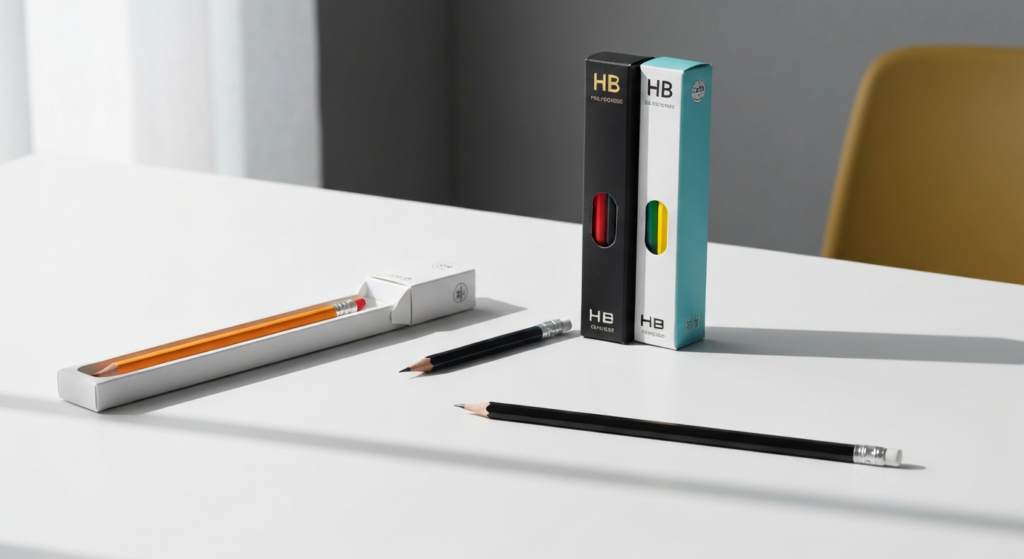
Pencils are frequently an impulse purchase, particularly during the “Back to School” season. In a crowded aisle filled with various brands, the packaging serves as the “silent salesman.” Traditional brown corrugated boxes do nothing to help a brand stand out, but ready shelf packaging pencils offer a secondary canvas for high-quality graphics and brand messaging.
When the outer lid of an SRP unit is removed, the remaining tray typically features the brand’s colors, logos, and key selling points (such as “Break-Resistant Core” or “Eco-Friendly Wood”). This creates a professional, cohesive look that draws the eye. Research from BrillPack emphasizes that SRP significantly improves product visibility, which is the first step in converting a browser into a buyer. By acting as a mini-display unit, the packaging ensures that even if the store is busy and the shelves are slightly messy, your pencils remain upright, front-facing, and visually appealing.
Improving the Consumer Experience: The Ease of Identification
From a consumer’s perspective, shopping for pencils can be surprisingly frustrating. A customer might be looking for a specific lead hardness (like a 2B for sketching or an H for technical drawing) or a specific aesthetic (like neon barrels or natural wood). If these products are shoved haphazardly onto a shelf, the customer has to hunt through the pile.
Ready shelf packaging pencils solve this by keeping products organized by SKU. The packaging acts as a physical barrier that prevents different types of pencils from mingling. This “easy to find, easy to buy” philosophy is a core tenet of modern merchandising. When the shopping experience is frictionless, customer satisfaction increases. As highlighted by the Packaging Corporation of America, focusing on the needs of both the merchandiser and the consumer creates a seamless ecosystem that ultimately drives higher sales volumes.
Comparison: Traditional vs. Ready-to-Shelf Packaging
To better understand the shift, let’s look at how these two methods compare across key retail metrics:
| Feature | Traditional Packaging | Ready-to-Shelf Packaging (SRP) |
|---|---|---|
| Stocking Speed | Slow (Individual unit handling) | Rapid (Bulk tray placement) |
| Shelf Organization | Prone to “leaning” and disarray | Fixed structure; keeps products upright |
| Brand Real Estate | Limited to the product box only | Extended to the display tray and header |
| In-Stock Visibility | Difficult to gauge depth | Easy to see when a tray is empty |
| Disposal | High volume of varied waste | Standardized, easy-to-flatten corrugated |
Supply Chain Resilience and Product Protection
The journey from a pencil manufacturing plant to a retail shelf is fraught with risks. Pencils, while seemingly sturdy, are susceptible to internal lead breakage if dropped or crushed. The graphite core is a ceramic-wax-clay mixture that can shatter inside the wood casing, rendering the pencil useless as it will “break” every time it is sharpened.
Ready shelf packaging pencils provide an extra layer of structural integrity during transit. Because the SRP tray is designed to fit snugly within a master shipper, there is less movement (vibration) during trucking and shipping. This protective “nesting” ensures that the product arrives in pristine condition. Furthermore, Modpac points out that SRP streamlines the entire supply chain, making it more agile. When the packaging is standardized, logistics providers can stack pallets more efficiently, reducing shipping costs and the carbon footprint of the product.
Strengthening Manufacturer-Retailer Relationships
In the competitive world of consumer packaged goods (CPG), being a “preferred vendor” is a massive advantage. Retailers prefer to work with manufacturers who make their lives easier. When a pencil brand provides high-quality ready shelf packaging pencils, they are essentially providing a value-added service to the retailer.
This commitment to the retailer’s operational health builds trust. A brand that invests in SRP is seen as a partner that understands the realities of store operations. This often leads to better shelf placement (eye-level positioning) and more frequent promotional opportunities. According to Vdriven, RRP acts as a “brand ambassador.” It shows that the manufacturer is professional, sophisticated, and dedicated to the success of the product once it leaves the warehouse. In many cases, having a robust SRP design is the deciding factor in whether a retail buyer chooses your brand over a competitor’s.
Sustainability and the “End-of-Life” for Packaging
Modern retailers are under immense pressure to reduce their environmental impact. Ready shelf packaging pencils contribute to sustainability goals in two ways. First, they often eliminate the need for additional plastic “shelf talkers” or dividers because the corrugated tray performs those functions. Second, because they are made from standardized corrugated cardboard, they are 100% recyclable and easy for store staff to process.
Once a tray of pencils is sold out, the associate simply pulls the empty cardboard tray off the shelf and flattens it for the recycling baler. There is no need to peel off plastic tape or separate different materials. As BPKC notes, the expedited disposal of packaging materials is a critical, yet often overlooked, benefit of the SRP model. It keeps the backroom clear of clutter and ensures the store remains a safe, efficient environment.
The Technical Design of Effective Pencil SRP
Creating effective ready shelf packaging pencils requires a deep understanding of both manufacturing and retail standards. It isn’t as simple as putting pencils in a box with a perforated lid. Designers must consider:
1. The Perforation Quality: The “tear” must be clean. If the cardboard edges are jagged or the tray rips during opening, the display looks cheap and unprofessional.
2. Structural Load: Pencils are heavy in bulk. The bottom of the tray must be strong enough to support the weight without sagging, especially if the trays are stacked on top of each other.
3. The “Finger Hole”: Many SRP designs include a small circular cutout at the back or front, allowing an associate to easily hook the tray and pull it forward or out of the master case.
4. Graphic Continuity: The artwork on the tray should complement the artwork on the individual pencil boxes, creating a seamless visual flow from the packaging to the product.
Conclusion: The Future of Stationery Merchandising
The transition toward ready shelf packaging pencils is a reflection of a broader trend in global commerce: the drive for hyper-efficiency. In an era of thin margins and rising labor costs, retailers cannot afford the “old way” of stocking shelves. They need products that arrive ready to work.
For pencil manufacturers, adopting SRP is no longer just a trend—it is a strategic necessity. It protects the product, slashes retail labor costs, maximizes shelf space, and provides a powerful marketing platform at the point of sale. By viewing packaging not as a “cost of goods” but as a “tool for growth,” stationery brands can secure their place on the shelves of the world’s largest retail chains.
As the retail landscape continues to evolve with the integration of automated warehouses and “click-and-collect” models, the importance of standardized, durable, and efficient packaging will only grow. For the humble pencil, the journey from the factory to the student’s hand is now shorter and more efficient than ever, thanks to the strategic implementation of ready-to-shelf packaging solutions.
Related Reading
- Why Pencil Set Packaging Affects Retail Sales
- How Factories Produce Multi-Pack Pencil Sets
- Why Retail Chains Prefer Specific Packaging Dimensions
- How Factories Produce Themed Pencil Sets for Brands
- Understanding EN71-9 Requirements for Pencil Packaging
- Why Retailers Request Drop-Test Certification for Pencil Packs
- Why Custom Branding Makes Retail Pencils Sell Better
- Why Retail Chains Prefer Foil-Stamped Logo Pencils
Share This Post
Share on facebook
Share on twitter
Share on linkedin
